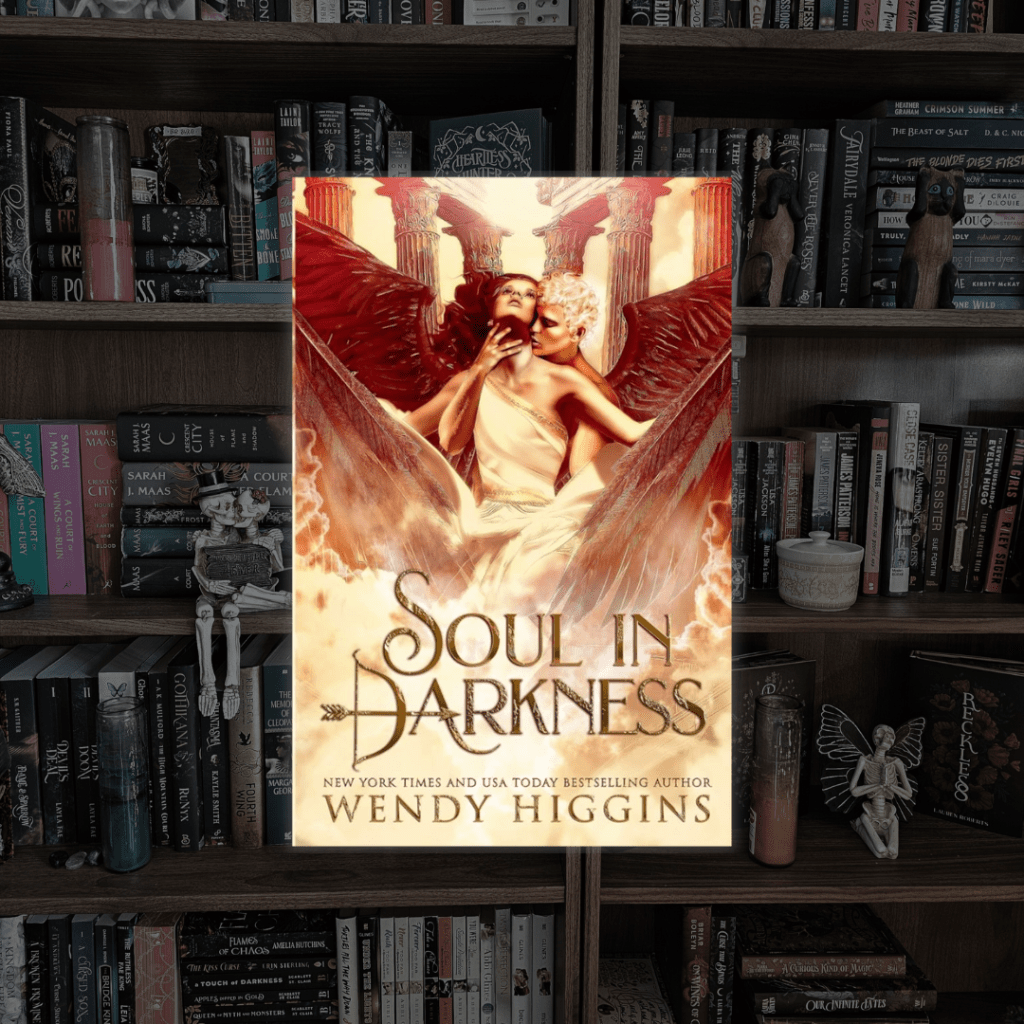
Soul In Darkness
Wendy Higgins
Read
·
07.15.19
—
07.17.19
Spice Rating:
Plot Rating:
My Rating:
Specs:
Young Adult
·
Epic Romantasy
Paperback
·
352 pages
What The Vibes Are
What It’s About
People travel from afar to the small isle in the Aegean Sea, hoping for a single glimpse of Princess Psyche. Their adoration for the mortal woman is so all-consuming that citizens begin to shower her with the very gifts and offerings they once left at the altar of Venus, goddess of love and beauty. But gods are known for their jealousy.
Cupid, the god of love, takes pleasure in causing strife and mischief in the lives of humans. He uses love as a weapon, humoring the weakness of people at the whims of their feelings. When his mother, Venus, approaches him about punishing the human girl who dares to steal her offerings and affections from the people, Cupid gladly accepts. Psyche’s punishment is to be given to a mysterious creature who only comes to her in the dark of night under the pact that she will never lay eyes on him. She is terrified of this stranger, whom the oracle described as a serpent. Her mate, however, is masterful in his dealings with his bride. He takes his time, morphing her fears into different sensations completely.
Based on the Roman/Greek mythology of Cupid and Psyche from Lucius Apuleius, New York Times bestseller Wendy Higgins brings the tale to life, weaving layers that show exactly how a sacrificial lamb can be enchanted by an unseen monster.
What I thought about it
***Possible Spoilers below
Wendy Higgins’ Soul In Darkness brings to life the Greek tale of Psyche and Cupid. The tales originate from Apuleius’ novel series Metamorphoses from the second-century. It follows a young princess whose beauty leaves men awestruck. It escalates to the point where they begin to forget about the goddess Venus and worship Psyche instead. This angers the goddess, and she sends her son, Cupid, to make her fall in love with the vilest of men as punishment for taking her offerings. But Cupid falls in love with her. Kidnapping her away under the pretense that she’s married a monster who only visits her at night, Cupid tries to prove to his mother that Psyche can love him. Venus agrees to the tell under the circumstances that Psyche mustn’t lay eyes on him until she has verbally confessed her love. When Psyche lights a candle while Cupid is sleeping and lays eyes on him, Venus puts her through a series of trials that no mortal has ever been able to complete. If Psyche completes each task, Jupiter will grant her eternal life, and she can live happily ever after with Cupid.
In part two of the book, we’re given a glance into Cupid’s mind and perspective on the tale, which gives us insight into the irrationality of the Gods. Higgins’ portrayed the Goddess’s jealousy and vanity so very well. I absolutely hated Venus. She was a spoiled brat whom you couldn’t rationalize with. She saw Psyche as a threat no matter what, and wanted her to pay for something that ultimately wasn’t her fault. I wanted to scream!
Conclusion
Wendy Higgins’ Soul In Darkness is a book that will leave you with withdrawals. After reading the last page, I sat there for a few minutes more and just took it all in. It had such a happy ending and was just so incredibly well-written. I want to read it all over again!!
What I love most about adaptations of these tales is the character development. The original tales are very one-dimensional, so to see a version of it so well developed was exciting. For instance, in Higgins’ version, Psyche may be extremely beautiful, but she didn’t see it—she wasn’t vain or stuck up. She’s a kind soul who was always happy. Another example was the development of her sisters. In the original tale, they are mentioned briefly as her sisters with no further context. But in Higgins’ version, her sisters are named, and their relationship is explained. Her eldest sister was with whom Psyche was the closest, while her middle sister suffered from severe envy and jealousy toward Psyche and was very cruel to her, despite Psyche’s attempts at kindness.
Have you read Soul In Darkness? What did you think? How did you feel about Higgins’ depiction of the Greek Gods? Comment below!
♡ G&P
 Grimoire & Poe
Leave a comment